

Here are some cool facts to break the ice with when you show up at your next party wearing a new gas mask.
Ancient Greece Apparently was a Smelly Place
The idea of covering your mouth and nose to protect yourself from bad smells, or worse, is a pretty old one! In fact, people in ancient Greece were using the common sponge as a gas mask thousands of years ago. It seems as though not everyone followed the Pythagorean Maxim.
At Least They Looked Cool
In the 17th century, “plague doctors” who treated patients afflicted with the bubonic plague wore a special costume. This was designed to protect them from miasma, or “bad air”, which they believed was the cause of the plague. This costume was distinctive for its odd-looking, beak-like mask. The “beak” was filled with sweet-smelling herbs and flowers, and was intended to sweeten the air breathed in by the doctors, thus nullifying the poison.

A Plague Doctor
The First Modern Gas Mask
The first modern gas mask was patented in 1847, by Lewis P. Haslett of Louisville, KY. Its design featured two one-way breathing valves, and a filter. The filter material was simply wool or some other material moistened with water. The mask was effective against solid particles, like dust.
Poison Gas in World War I
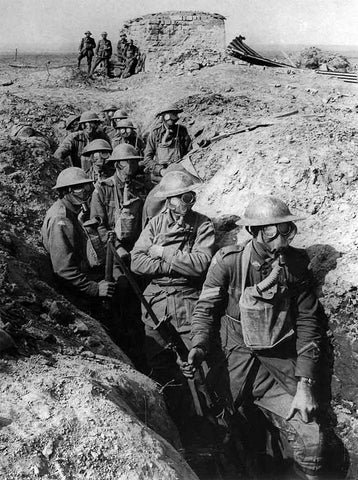
Gas masks were first mass-produced for the military in the First World War, after the German Army attacked with poisonous chlorine gas in the Second Battle of Ypres. The effect of the gas was devastating, with 5,000 Allied soldiers killed and 15,000 wounded. Both sides immediately started developing effective gas masks.

Australians wearing gas masks at Ypres in 1917
Don’t Throw Out Those Pits!
The best absorbent of poison gases in World War I was found to be charcoal made from shells and pits of various nuts and fruits like coconuts, chestnuts, and peaches. These materials were collected in public recycling campaigns.
The “Gas” Menagerie
Gas masks were made for dogs and horses during the First World War as well, as these animals were used on or near the front lines.

German horse gas masks being used by transport horses
Make Sure They Fit
During the Iran-Iraq War (1980-88), Iraq used chemical weapons against Iran. Iran was unprepared for this kind of attack, and needed gas masks in a hurry. The Iranian military then purchased gas masks from South Korea, but were surprised to learn that gas masks designed for East Asian faces did not fit a typical Iranian face. (The filters also only lasted for 15 minutes.)
It’s Probably Better Not to Buy Gas Masks on Sale
When the Iranians found 5,000 East German gas masks at a bargain price, they snapped them up, sight-unseen. Unfortunately, they got what they paid for, as the saying goes. The cheap “gas masks” were just goggles for spray-painting.
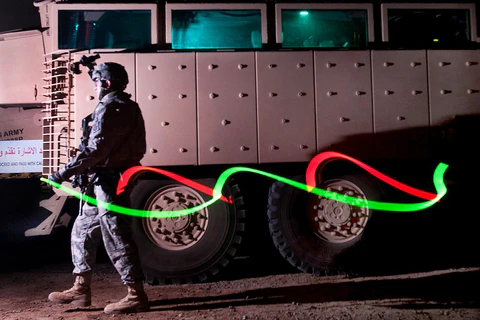
Glowsticks – you can buy them almost anywhere. They’re a cheap way to liven up a concert, great for camping, and guaranteed to make a sleepover with friends a little more interesting. And, they’re standard issue in the military.
In fact, the biggest buyer of glowsticks today (also known as chemlights), is the U.S. Department of Defense. It turns out there are many more uses for these little tubes, and not all of them are as cute as a weekend slumber party.
The technology behind glowsticks was first discovered in 1962 by a New Jersey chemist, Dr. Edwin Chandross. While experimenting with light producing chemical reactions, he carried out experiments to determine which chemicals would produce light most efficiently. After a day’s experiments, he found that a mix of hydrogen peroxide combined with oxalyl chloride and dye would produce a soft glow. However, the light was pretty weak, just 0.1% of the light emitted by today’s glowsticks.
Researchers at American Cyanamid then continued tinkering with the formula, eventually finding that substituting phenyl oxalate for the oxalyl chloride produced a far stronger light. They named this compound Cyalume.
Over the next decade or so, various patents were issued to new glowstick devices. In 1976, a patent was given for a plastic tube with a glass ampule inside. When the tube was bent, the glass cracked, causing the chemicals to mix. Glowsticks today are based on this design.
Interestingly enough, one of the first industries to realize the benefit of this chemical discovery was the military. The Navy acquired a patent in 1973 for a glow device, and put it to work in its operations.
It turned out that these little glowsticks had some serious advantages. They didn’t require batteries, were cheap to produce, had a long shelf life, could tolerate high pressures, were water and weather proof, and visible from a mile away in the right conditions.

Today, glowsticks are used by all branches of the military, for a multitude of purposes.
Some of these uses are:
Night Operations
Glowsticks are a help with visibility at night. They’re particularly useful for mitigating hazards by marking them off.
The military also has infrared glowsticks, which are great for marking targets, landing zones, friendly forces, and anything they don’t want to use visible light for.
Hazardous Conditions
Because glowsticks are non-flammable and don’t spark, they’re ideal for using near technological hazards and in natural disasters. They can also be used underwater.
Room Clearing
Glowsticks are a simple and easy way to mark which rooms have been cleared. Just crack one and toss it in the cleared room.
Minefield Marking
An obviously useful purpose of glowsticks is letting soldiers know where a minefield is located.
Route Marking
A very effective and easy to make sure that troops don’t take a wrong turn. (If only Hansel and Gretel took some into the woods that day.)
Survival and First Aid Kits
Glowsticks are an absolute necessity in survival situations.
Search and Rescue
Ideal for water rescue operations, in particular, since they float and are waterproof.
Glowsticks are so vital to military ops, that chemlights are issued with various durations, sizes, shapes, light intensities, colors, and also in infrared. The Dept. of Defense reportedly orders about 20 million of them a year!
As an interesting end-note, Dr. Chandross didn’t even get a patent. He was working at Bell Labs, and apparently nobody thought the formula would be that useful.

What Are Bulletproof Vests?
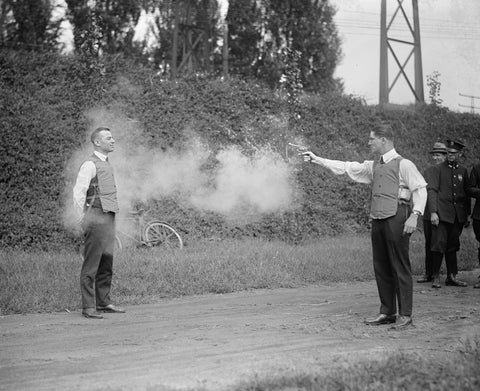
Bulletproof vests, and plate carrier vests are specific types of body armor designed to absorb and block bullets, projectiles, and fragmentation.
It’s important to note that there is no such thing as a completely “bulletproof” vest or armor. The most that these types of armor can do is offer some degree of protection, but there is always an element of vulnerability.
In this post we’ll go over the history of bulletproof vests, briefly, discuss different types of body armor, relative effectiveness, and advantages and disadvantages of each.
A Brief History of Bulletproof Body Armor
Throughout history, armor was usually worn in battle to protect against swords and other edged weapons. However, with the advent of firearms in the 16th and 17th centuries, the armor that could protect against the new weapons was simply too heavy to worn in battle.
During WWI, armor was brought back, this time to protect against shells. This type of armor was used on a small scale, and was also too heavy to be of practical use.

By WWII, a lighter armor was developed made of overlapping plates of steel, aluminum, or bonded fiberglass attached with a nylon garment, covering both the front and back of the wearer. Called “flak jackets”, these vests were flexible and protected against shells, but could not stop armor piercing bullets. Overall, they were not very effective and their function was more psychological than anything else.
By the 1960’s, vests were developed that had plates of composite layers of steel, boron carbide (a hard ceramic), or plates made of a hard plastic known as polyethylene, or PE.
Researchers made a momentous discovery in the early 70’s when they found that numerous layers of nylon fabric could dissipate the energy of a bullet. And with the invention of Kevlar in 1971, a fabric was available that was five times stronger than steel on an equal weight basis.
By stitching together many layers of Kevlar – anywhere from 8 to 48 layers – armor manufacturers could create a bulletproof vest that would effectively stop a bullet by causing to it flatten and mushroom against the fabric, thus dissipating its impact energy.
Two Types of Modern Body Armor
There are two general types of body armor, each with its specific purpose, advantages, and disadvantages.
Soft armor, ballistic, or bulletproof vests are made of soft, fabric like material (usually Kevlar) and are typically worn by police officers, security professionals, and private citizens. They’re designed to protect against low-caliber bullets and edged weapons.
Hard armor, known as plate armor, consists of a vest with plates of hard armor inserted into pouches sown into the vest. Plate carrier vests are usually worn by military personnel, who are exposed to high-caliber bullets and rifle rounds.
Effectiveness
Both soft and hard armor are not actually bulletproof. They’re only bullet resistant, and even when they do their job and the bullet does not penetrate, the wearer is usually bruised, and can sometimes be seriously injured.
Moreover, full body protection is impossible. Kevlar vests cover the front, sides, and back of the torso, and plate armor only protects the front and back.
Comparison of Soft Vests and Plate Armor
Kevlar vests are made of flexible fabric. This makes them quite versatile and easy to wear. Depending on the number of layers, they can stop 9mm and .40 caliber bullets, and can even protect against .357 and .44 magnum hollow points.
Plate carrier vests are a lot less flexible, but much stronger. The plates can be made of steel, ceramic, or PE. Manufacturers classify body armor plates into two classes. Level III can protect against 7.62mm full metal jacket bullets, and Level IV is supposed to block 30.06 armor piercing bullets.
Both types of armor have their advantages and disadvantages. Vests are lightweight and easy to conceal; just how easy it is to conceal them depends on the number of layers. They feel more or less like regular clothing, and can be worn under clothes. They also wrap entirely around the torso, covering the front, ribs, and back, thus providing protection to a large area. They are usually a good choice for civilians who want to wear them inconspicuously.
Plate carriers are heavier, and must be worn over the wearer’s clothes, making them difficult to hide. Additionally, only the front and back of the torso are protected, leaving the sides exposed. However, they’re the best protection against rifle threats, and the ideal choice for soldiers. They’re also easy to put on and take off.
What Kind Should You Get?
When deciding whether to get a plate carrier or vest, you should determine the nature of the threat that you’re trying to protect against. Law enforcement and private security will usually be adequately protected with ballistic vests. These will guard against edged weapons and low caliber bullets. They’re also the best choice for civilians who don’t want many people to know that they’re wearing body armor. Military personnel and those facing threats from high caliber bullets and rifle shots should wear plate carrier vests.
Stay safe out there!
On June 6, 1944, the world witnessed a pivotal event that would alter the course of World War II, and change the face of the Europe. Operation Overlord, commonly known as D-Day, marked an extraordinary turning point in the war, representing the valiant efforts of the Allied forces to confront and eradicate the menacing Nazi threat. This all-out assault on the beaches of Normandy showcased the indomitable spirit, bravery, and heroism of the Allied Forces.
The Stakes: A Battle for Freedom
As the sun rose on that fateful day, the world held its breath. The stakes were monumental, with the Allied forces facing an insidious adversary intent on spreading tyranny and oppression across the globe. The Nazis, under Hitler’s command, had already subjugated nearly the entire European continent, and caused unimaginable human suffering. D-Day marked a definitive moment in which the Allies mobilized their collective might to liberate Europe and ultimately rid the world of this evil.
Immense Planning and Logistics
The success of D-Day was predicated on meticulous planning and extensive training. Months of preparation went into orchestrating this audacious assault, involving thousands of soldiers, sailors, airmen, and support personnel. The logistics were staggering, encompassing the coordination of air and naval power, the gathering of intelligence, and the assembling of troops and equipment on an unprecedented scale.

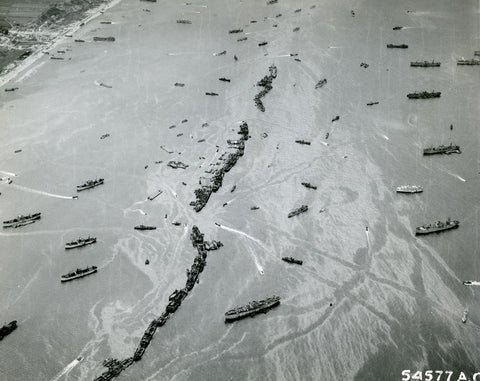
Overhead view of American Liberty ships acting as makeshift breakwaters off the Normandy invasion beaches, June 1944. Dozens of ships, dubbed “corncobs” for the purposes of this operation, were intentionally sunk roughly 1,000 yards offshore to create “Gooseberry” breakwaters for the Mulberry artificial harbours at Omaha and Gold beaches.
The Allied Heroes
As the landing craft hit the beaches of Normandy, the bravery of the Allied troops shone through. The assault forces consisted of men from various nations, united by a common purpose: to halt the Nazi onslaught and restore freedom. They faced a storm of bullets, artillery fire, and treacherous terrain.
The soldiers who stormed the beaches demonstrated extraordinary valor in the face of unimaginable danger. They forged through the chaos, scaling cliffs, dodging enemy fire, and enduring heavy losses to secure vital beachheads. Their courage and sacrifice laid the foundation for the liberation of Europe and the eventual defeat of Nazi Germany.
The Airborne Forces: The Pioneers of D-Day
The airborne forces played a crucial role in the success of D-Day. Paratroopers from the United States, Britain, Canada, and other Allied nations were dropped behind enemy lines, tasked with capturing key objectives, disrupting German defenses, and securing vital strategic positions. Their daring exploits and resilience paved the way for the troops landing on the beaches, effectively ensuring their success.
The Human Cost
The price of victory on D-Day was high, with thousands of lives lost in the quest for freedom. The beaches of Normandy were transformed into a battleground soaked in the blood of heroes. Each fallen soldier represented a life cut short, a family forever changed, and dreams left unfulfilled. It is important to remember and honor their sacrifice, as it was through their unwavering commitment and bravery that the tide of the war turned in favor of the Allies.
The Legacy of D-Day
D-Day marked a turning point in World War II, heralding the beginning of the end for Nazi Germany. It served as a testament to the power of unity, determination, and sacrifice in the face of overwhelming adversity. The successful invasion of Normandy paved the way for the liberation of Europe and the eventual defeat of the Axis powers.
D-Day stands as an enduring testament to the heroism of the Allied troops who fought to vanquish the Nazi menace. It symbolizes the unwavering commitment to freedom, justice, and humanity exhibited by those who participated in the operation. Their selflessness, courage, and sacrifice remind us that, even in the darkest of times, the triumph of good over evil is possible. D-Day will forever be etched in history as a turning point that reshaped the course of World War II and helped secure a brighter future for generations to come.